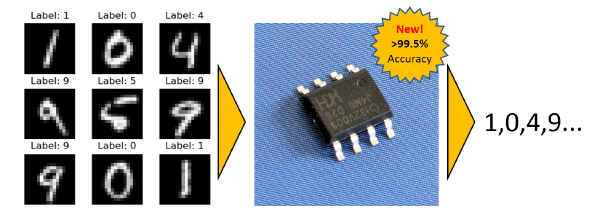
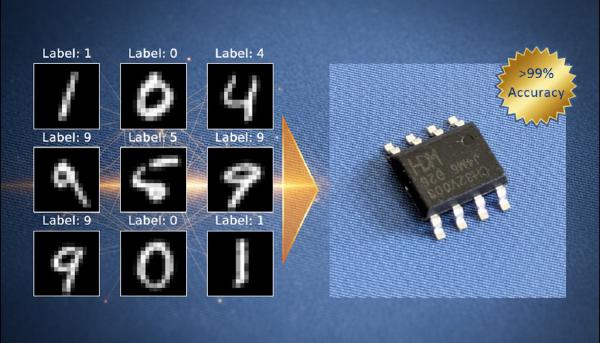
Combining a deep-depthwise CNN architecture with variable quantization in BitNetMCU achieves state-of-the-art MNIST accuracy on a low-end 32-bit microcontroller with 4 kB RAM and 16 kB flash.
Todays candles have been optimized not to flicker. But it turns out when we bundle three of them together, the resulting triplet will start to naturally oscillate. Amazingly, the frequency is rather stable at ~9.9 Hz as it mainly depends on gravity and diameter of the flame. We detect the oscillation with a suspended wire and divide it down to 1 Hz.
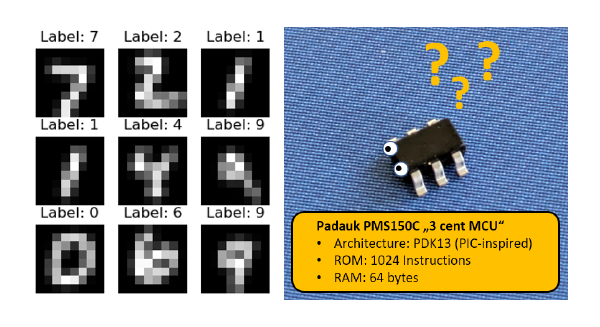
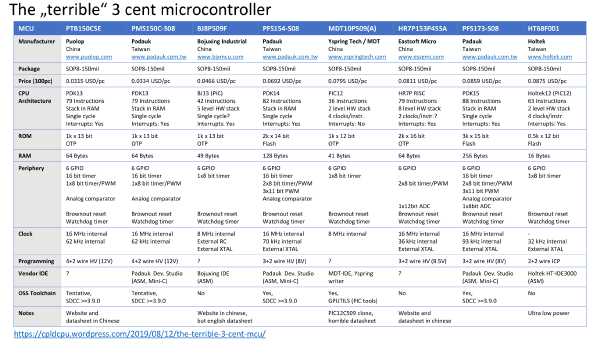
Is it possible to implement reasonably accurate inference of MNIST, the handwritten numbers dataset, on a “3 cent” Microcontroller with only 64 bytes of RAM and 1K of instruction memory?
BitNetMCU is a project focused on the training and inference of low-bit quantized neural networks, designed to run efficiently on low-end microcontrollers like the CH32V003. Quantization aware training (QAT) and fine-tuning of model structure allowed surpassing 99% Test accuracy on a 16x16 MNIST dataset in only 2kb of RAM and 16kb of Flash.
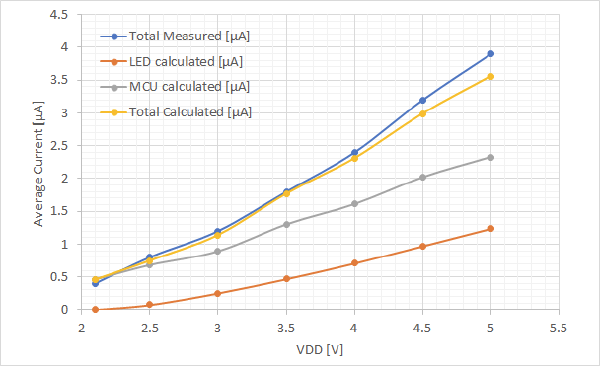
Flashing a LED is certainly among the first set of problems any burgeoning electronics specialist is tackling, may it be by using an ancient NE555 or, more recently, a microcontroller to control the LED. As it turns out, we can turn any trivial problem into a harder one by changing its constraints.
Implementation of the optimized light_ws2812 driver with hand crafted assembly inner loop that bit-bangs LEDs even at 4 MHz without timing violations on an AVR.