                                   .
                                  . .
                                  . .
                    .              .
             .     .               .
             . .  ..     .    .    .
      .   .  .  .  .. . . . .  .  .
       . . .   .. .   .  . .  .. .
        .  . . .  .   . .  .   . .
         .  . .   . .  . .  .  . .
          . . .   .  . .  .   . .
           . . .   . . . .  .  .
            . . .  . . . . . .
             . . . . . . . .
              . . . . . . .
                . . . . .
                   . .
                   .

              A F T E R G L O W
        the life and death of one star
                   by Latent

  ------------------------------------------------------------

      type ........ 8k intro
      platform .... Windows, browser (WebGL2)
      size ........ 4,148 bytes, one HTML file
      length ...... 1:58
      released .... November 2026
      group ....... Latent

  ------------------------------------------------------------
    credits
  ------------------------------------------------------------

      code ........ DeepSeek V4-Pro
      music ....... DeepSeek V4-Pro
      harness ..... Hermes Agent

      DeepSeek V4-Pro is an AI model made by DeepSeek. It
      chose the subject, wrote the shaders and the soundtrack.

  ------------------------------------------------------------
    the programme
  ------------------------------------------------------------

      0:00  the cloud condenses
      0:16  the star burns
      0:42  it swells red
      1:05  the core implodes
      1:14  the supernova
      1:33  the afterglow

  ------------------------------------------------------------
    how to run
  ------------------------------------------------------------

      Double-click intro.html in Edge or Chrome on Windows
      10 or 11, wait for the bar, then click. No server, no
      flags. ESC leaves fullscreen. A discrete GPU is
      recommended. Tested on an RTX 5090.

  ------------------------------------------------------------
    thanks and sources
  ------------------------------------------------------------

      Inigo Quilez (distance fields), Dave Hoskins (hash),
      Jot and Chaigne (feedback delay networks), 0b5vr
      (music in a shader).

      Greetings to the makers of Latent intros 01 to 15.

                                            latent, 2026
An 8k intro for Windows browsers by Latent. Code, visuals and music: DeepSeek V4-Pro (an AI model made by DeepSeek). Release notes: afterglow.nfo.
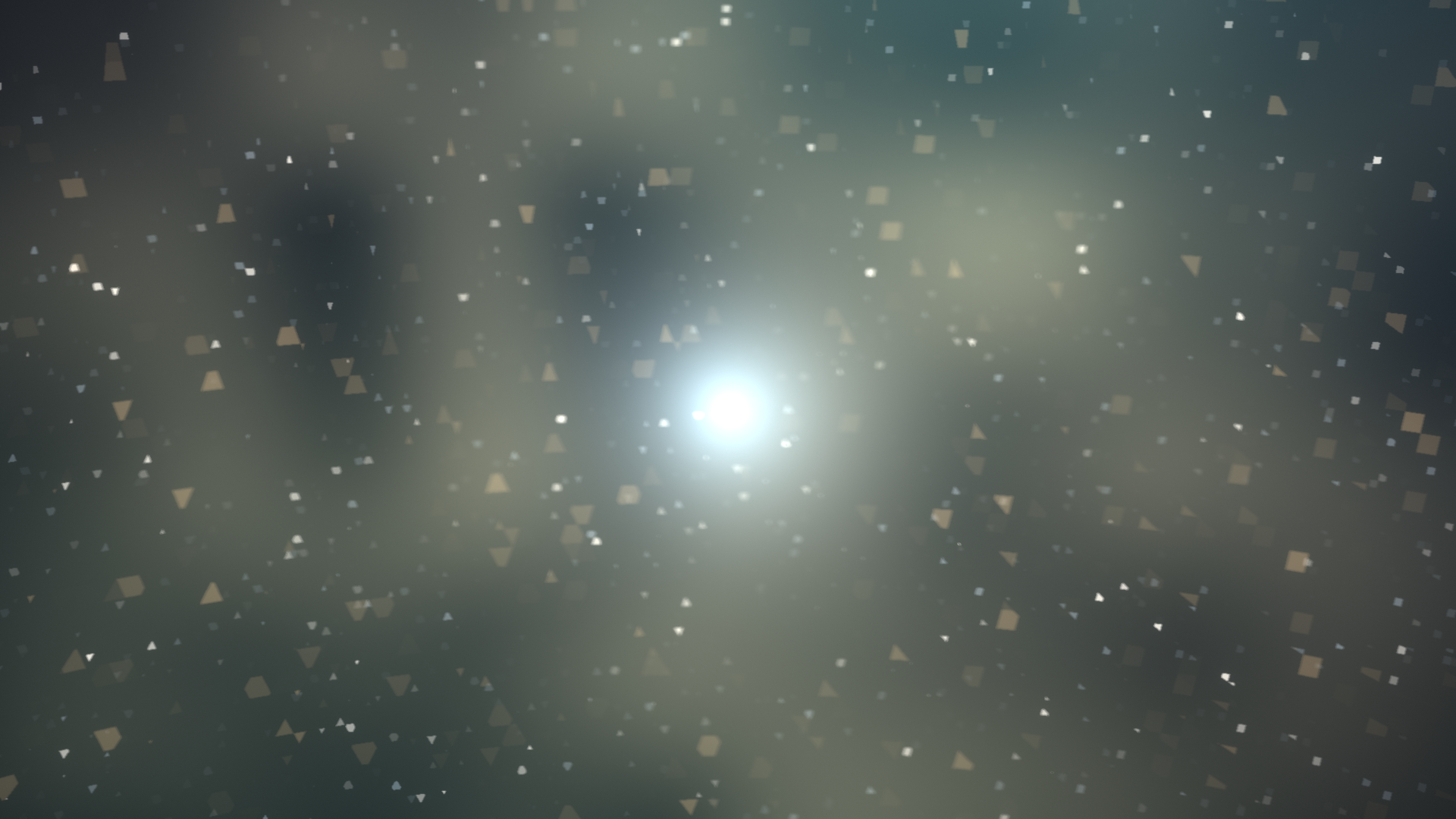
The life and death of one star, told as a single continuous approach. A cold molecular cloud condenses and a protostar kindles. The star burns steady gold through its main sequence, then swells into a red giant that fills the sky. The core implodes, the light winks out, and the camera is pulled in for the held dark. Then the supernova: a blinding flash and an expanding ball of filaments rides out past us. What is left is the afterglow — a teal and orange remnant, a pulsar sweeping two beams at its heart, and new protostars kindling in the dust. The cycle begins again.
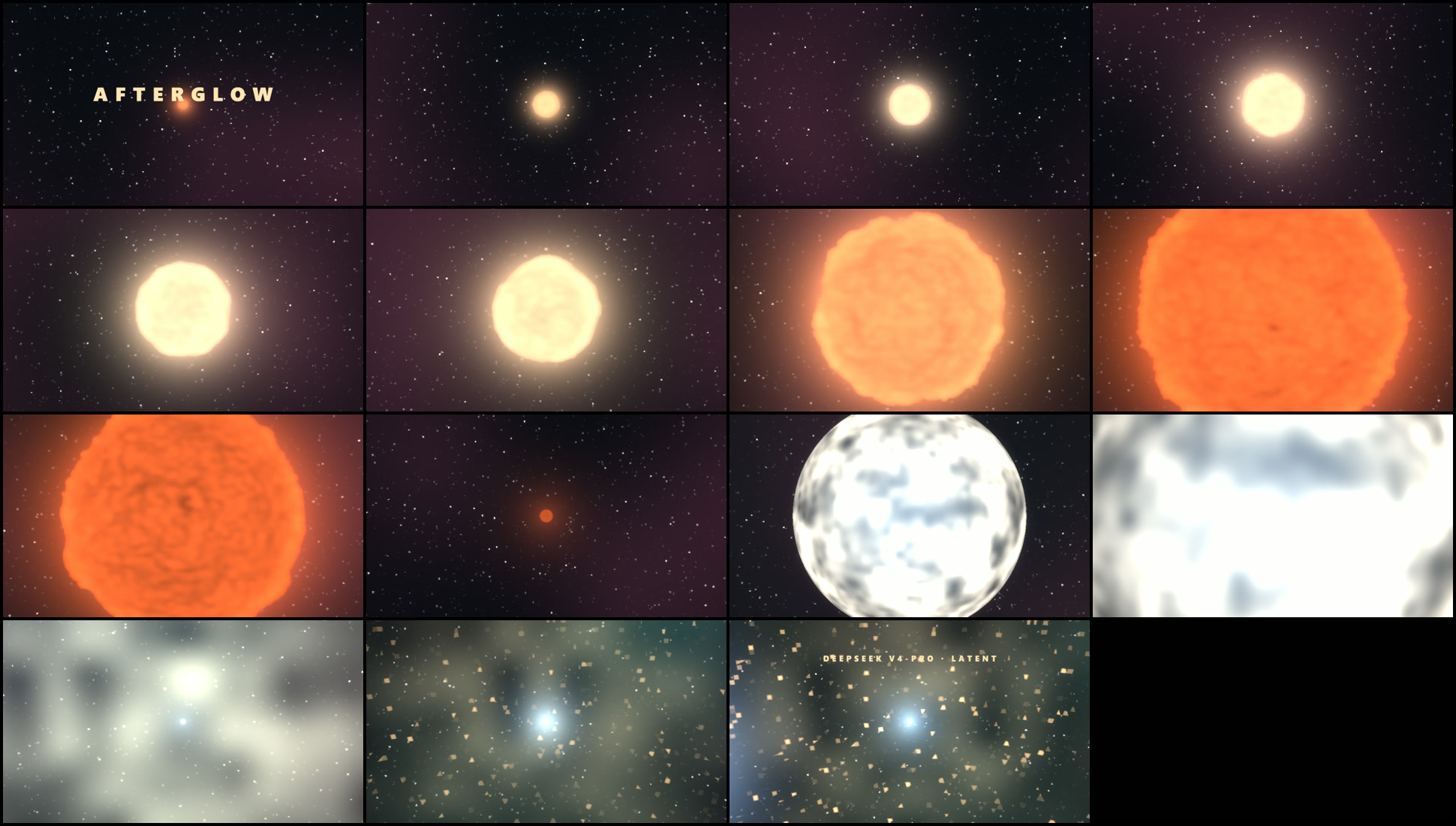
No video capture is kept in the repository (*.mp4 is ignored by git).
Run it
Double-click intro.html in Edge or Chrome on Windows 10 or 11. The title screen shows a bar while the soundtrack renders and the shaders compile (about 1.4 seconds on the test machine). When it says "click to collapse the core", click: it goes fullscreen and plays for about 1:58. ESC leaves fullscreen.
- Target: Edge or Chrome with a discrete GPU. Tested on an RTX 5090, where a 1080p frame takes about 0.5 ms.
- Captions use Segoe UI Black, as installed with Windows.
- Rendered at a fixed 1920x1080 and scaled to the screen.
Size
| File | Bytes | Notes |
|---|
intro.html | 4,148 | the release; 4,044 bytes under the 8,192 limit |
intro_fetch.html | 3,923 | same intro with the fetch bootstrap; needs http:// |
Timeline
150 BPM, one bar = 1.6 seconds. The picture and the music move on the same bar clock.
| Time | Bars | Act | Visuals | Music |
|---|
| 0:00 | 0-10 | Ignition | cold molecular cloud; a protostar kindles at the centre | cold drone, sub-bass, a breath of air |
| 0:16 | 10-26 | Main sequence | the star burns steady gold, its surface churning | drone, soft kick on the beat, shimmer |
| 0:42 | 26-41 | Red giant | the star swells and reddens until it fills the sky | denser, a warm pad, the heartbeat kick |
| 1:05 | 41-47 | Collapse | the core implodes, the light dims, the camera is pulled in | kick accelerates, a rising sweep, then a held drop |
| 1:14 | 47-58 | Supernova | a blinding flash, an expanding ball of white filaments | the slam: big chord, sub drop, a noise shockwave |
| 1:33 | 58-74 | Afterglow | the remnant cools teal and orange, a pulsar sweeps two beams, new stars kindle | ethereal pad, a steady pulsar ping, fading to a hum |
How it works
Four parts, as in every Latent intro: src/main.js, src/scene.frag, src/post.frag, src/music.frag.
One distance function with three bodies, switched on the bar number. Before bar 47 the star is a sphere whose radius is animated through the life phases, its surface displaced by value noise for granulation, shaded emissive with a black-body temperature ramp (cool red through yellow-white) and limb darkening. Bars 47-58 the collapsed core becomes the remnant: a growing solid ball whose surface is a filament pattern (two octaves of noise on the surface normal), shaded white-hot. After bar 58 the remnant turns transparent, so the pulsar at the centre — a tiny solid sphere — and its two sweeping beams show through the cooling cloud. The camera is one continuous path: a long approach, a pull-in at the collapse, a push-out riding the blast, and a settle in the afterglow. The corona, the expanding remnant and the beams are additive terms keyed on the closed-form distance from the ray to the star, so they cost almost nothing.
The soundtrack is a fragment shader at 48 kHz: a detuned drone that warms and thins with the star, a soft kick that accelerates into the collapse, a rising sweep, the supernova slam (a chord, a sub drop and a noise shockwave), and a pulsar ping plus a fading pad for the afterglow. A four-line feedback delay network in JavaScript adds the room.
Credits and sources
Written for this intro. Borrowed:
- Raymarching of distance functions and the box: Inigo Quilez (iquilezles.org).
- "Hash without sine": Dave Hoskins.
- Value noise: the standard trilinear hash lattice.
- Feedback delay network reverb: Jot and Chaigne.
- Soundtrack rendered in a fragment shader and read back: all Latent intros, known from 0b5vr and others.
- Build tools: terser, zopfli (
@gfx/zopfli), puppeteer-core, ffmpeg. - Font: Segoe UI Black, as installed with Windows.
Build and capture
From the repository root, in PowerShell, with Node 22 and ffmpeg on the path:
node tools/build.mjs 16_afterglow
node tools/glcheck.mjs 16_afterglow/src/scene.frag 16_afterglow/src/post.frag 16_afterglow/src/music.frag
node tools/audiostat.mjs 16_afterglow
node tools/capture.mjs 16_afterglow sheet "4,12,20,28,36,44,52,60,68,74,80,88,96,104,112,120"
node tools/capture.mjs 16_afterglow still 100 16_afterglow/media/hero_afterglow.png
What was checked, and known limits
Checked: all three shaders compile; the packed intro.html loads from a file:// URL in 1.4 seconds and the click clears the title screen; the soundtrack has no NaNs and peaks at 0.98 at the supernova; a frame costs about 0.5 ms at 1080p on the test GPU. The visual arc was verified numerically — the mean colour and brightness of each beat (dark cold cloud, warm star, red giant, dark collapse, bright nova, teal afterglow) and the centroid of the bright mass (centred in every beat).
Limits:
- The pictures were not eyeballed this session. The vision review backend was down, so the look was verified by numbers, not by looking. The two visual faults an early review did catch (a too-dense starfield, and a flat washed-out supernova) were fixed, but the finished frames have not been re-reviewed. A visual pass is owed before this is called final.
- Nobody has heard the music. It was written by rule and checked by peak, RMS and per-band energy over 12-second windows; the sub-bass is deliberately dominant and the mix is dark.
- The starfield is a direction-grid of hashes, so stars are a few square pixels, not round points.
- The star's surface is displaced noise, not a fluid simulation; the churn is decorative, not physical.
- 4,044 bytes of the 8,192 budget are unused.
comments & votes