                     ..    ..   ...   .
              .        .        -#%@@@@@@%#=.
       .          .:=*@@@@@@@@@@@@@@@@@@@@@@*+-.
   .        .:-+#@@@@@@@@@@@@@@@@@@@@@@@@@@@@@@@@@%*-.
        .:-=+*#%@@@@@@@@@@@@@@@@@@@@@@@@@@@@@%#*+=-:.
     .:-=+*#%@@@@@@@@@@@@@@@@@@@@@@@@@@%#*+=-:.
                    .::--===++++===--::.        ~~       ~
   ~ ~ ~ - ~ ~ ~ - ~ ~ ~ - ~ ~ ~ - ~ ~ ~ - ~ ~ ~ - ~ ~ ~ - ~
      ~     ~    ~     ~    ~    ~     ~    ~     ~    ~
                 S O U N D I N G
  ------------------------------------------------------------

      type ........ 8k intro
      platform .... Windows, browser (WebGL2)
      size ........ 6,928 bytes, one HTML file
      length ...... 2:08
      released .... November 2026
      group ....... Latent

  ------------------------------------------------------------
    credits
  ------------------------------------------------------------

      code ........ DeepSeek V4.1 Flash
      music ....... DeepSeek V4.1 Flash
      harness ..... Ori Code

      DeepSeek V4.1 Flash is an AI model by DeepSeek. It wrote
      the shaders and the soundtrack. It could look at rendered
      frames but could not hear the music, so the mix was
      balanced by numbers alone (per-band spectra, not ears).

  ------------------------------------------------------------
    what you see
  ------------------------------------------------------------

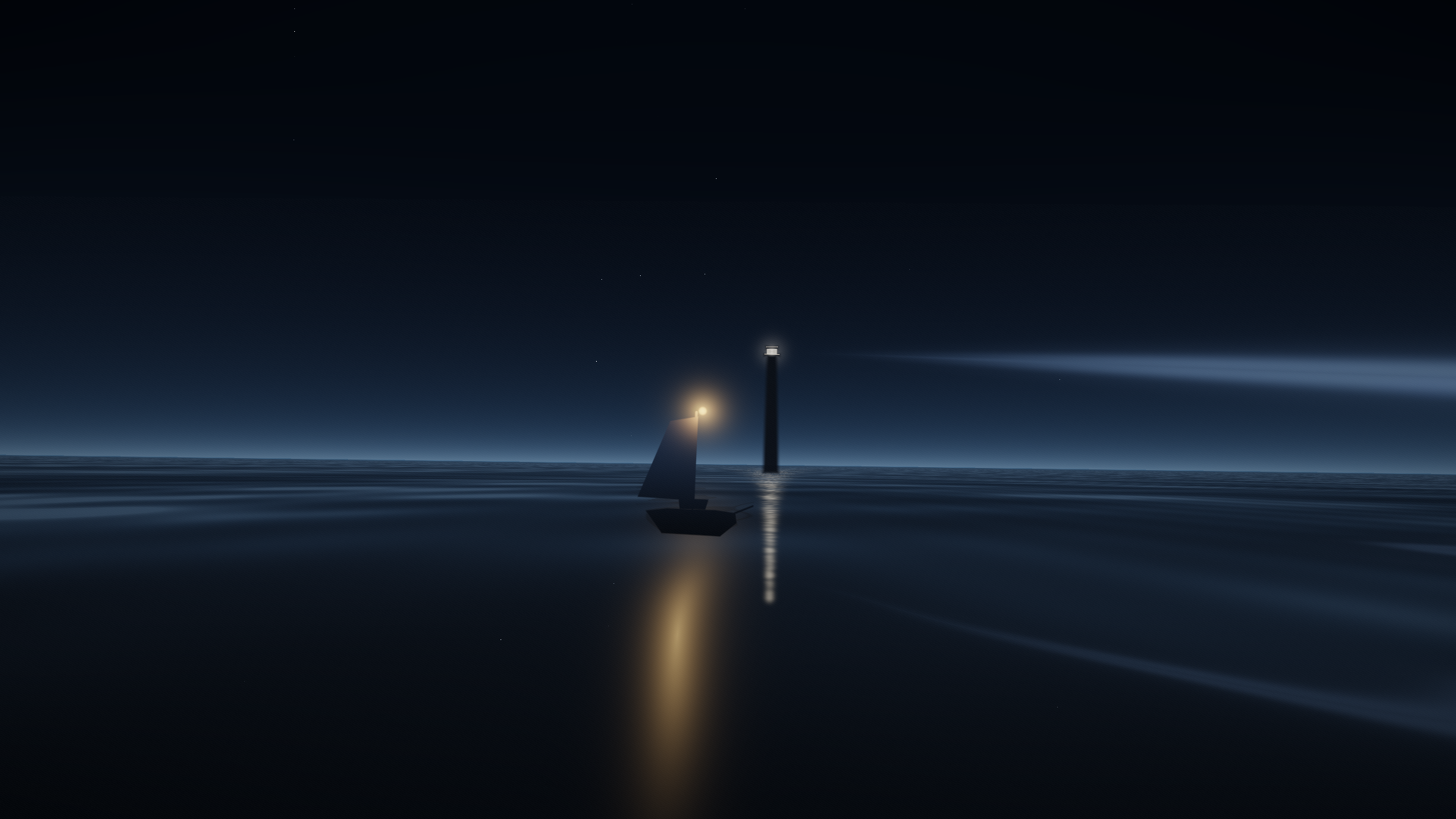
      night. open sea. no moon.
      one small boat with one lantern, and a lighthouse
      miles off that sweeps its beam through the fog.

      the light does not rescue anyone. it keeps the watch.

      0:00   black water, the lighthouse dark
      0:15   the lamp comes on
      0:27   the beam crosses the boat; the hull goes black
      0:44   the swell deepens; the beam's pool widens
      1:04   the sweep finds the others: twelve lanterns
      1:16   the camera climbs; the fleet is out there
      1:40   the watch
      2:08   end

  ------------------------------------------------------------
    how to run
  ------------------------------------------------------------

      Double-click intro.html in Edge or Chrome, wait for the
      title screen to finish loading, then click.
      No server, no flags. ESC leaves fullscreen.
      A discrete GPU is recommended. Tested on an RTX 5090.

  ------------------------------------------------------------
    how it is made
  ------------------------------------------------------------

      - the beam is a closed-form line integral of a gaussian
        cone through the fog, not a marched volume: no ray can
        slip past it and there is no step to undersample. The
        same integral lights the sea, the reflection and every
        fleet lantern
      - the sea is one plane with six gravity-dispersed waves
        on a golden angle, so the normal is exact; it carries
        the beam's torn path, the pool where the cone lands,
        and the tower's and boat's reflections as streaks
      - the tower and the boat are flat cut-outs drawn nearly
        black on the fog; the lantern's own warm light is the
        only thing that plays on them
      - post: halation above a threshold, ACES, vignette, and
        grain seeded by the frame, weighted to the shadows
      - the soundtrack is a fragment shader: one pixel per
        stereo sample at 48 kHz, 90 BPM in 3/4, a barcarolle
        in D minor. Cello tune, harp waltz, foghorn, bell-buoy,
        sea, a chime cluster for the fleet. One bar is 2 s, so
        the beam's 16 s revolution is exactly 8 bars
      - the room is a 4-line Householder FDN in JavaScript
      - packed with zopfli into an HTML comment and unpacked by
        DecompressionStream, so it runs from file://

      Source, build tools and notes are in this folder; see
      readme.md.

  ------------------------------------------------------------
    thanks
  ------------------------------------------------------------

      No assets or libraries are included. Techniques: Inigo
      Quilez (value noise and the distance-field canon),
      Krzysztof Narkowicz (the ACES fit used in post), and the
      FDN reverb structure shared by all Latent intros. The
      beam integral is standard analytic geometry: the closest
      approach of a ray to an axis, then a gaussian in the
      perpendicular distance.

      And to whoever kept the light on, on a night nobody
      was watching.

  ------------------------------------------------------------
    greetings
  ------------------------------------------------------------

      to everyone who still counts bytes,
      to everyone who has sailed at night and watched
      a light come round again,
      and to the keepers, who were the only ones awake
An 8k intro for Windows browsers by Latent. Code, visuals and music: DeepSeek V4.1 Flash. Release notes: sounding.nfo.
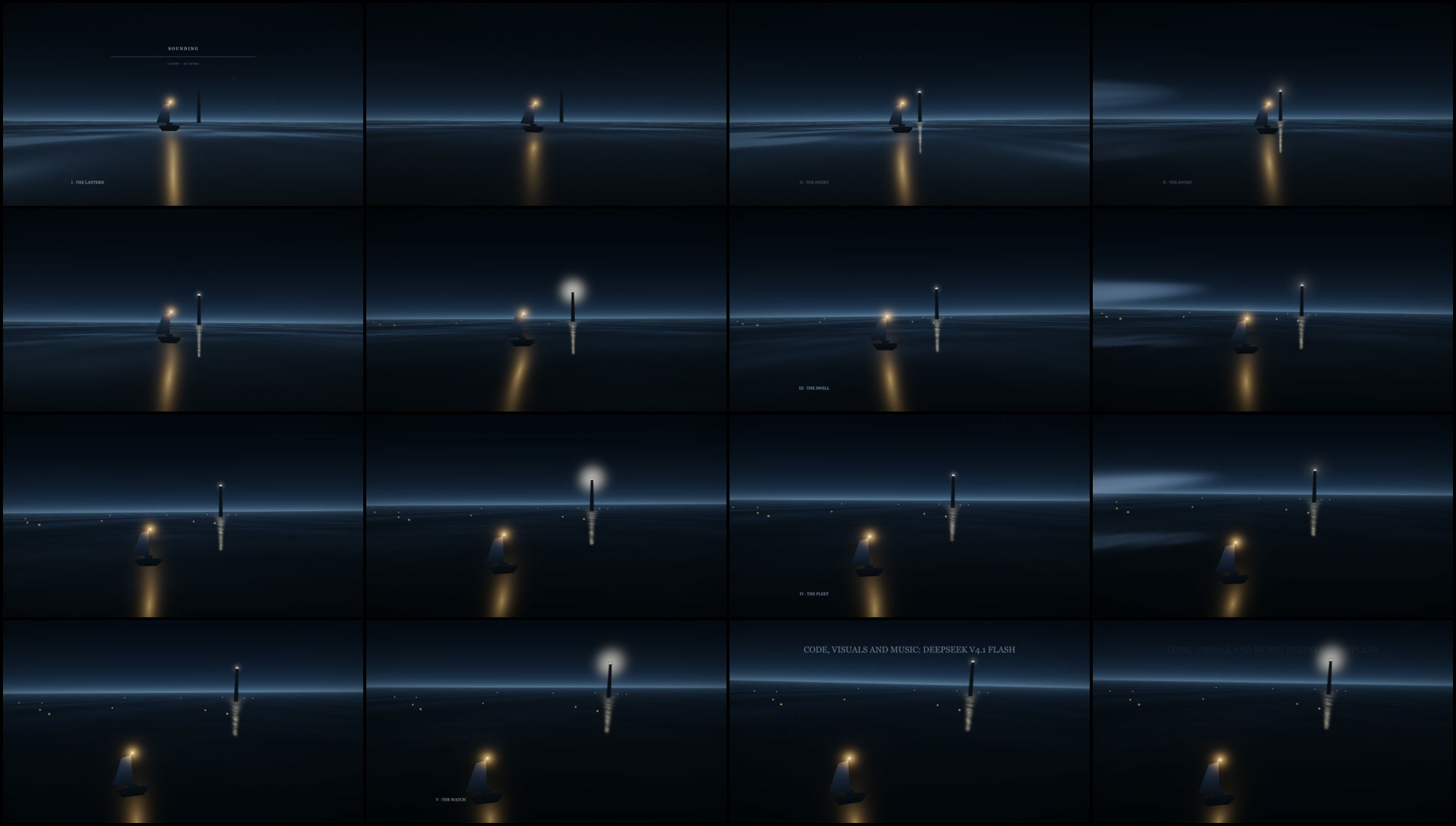
A sounding is the leadsman's call of the depth under a ship — the oldest way of knowing where you are — and also the noise a foghorn makes into nothing. This intro is about the light that does that work at night: a lighthouse beam turning through the fog, and one small boat that keeps its own lantern.
Night, open sea, no moonlight, two colours only: the cold white of the beam and the amber of the flame. The beam is a real cone in a scattering medium, it throws a pool of light onto the swell and a torn path back to the lens, and it passes over the boat. From about 0:34 other lanterns fade up out there, a scattered fleet, each one brightening as the beam crosses it and dimming back to its own faint glow: all of them feeling their way. It does not rescue them. It only keeps the watch.
No video capture was made for this one.
Run it
Double-click intro.html. A title screen lights a lamp while the soundtrack is rendered and the shaders compile (about 1.3 s here). When it says "click to begin", click: it goes fullscreen and plays for 2:08. ESC leaves fullscreen.
- Target: Edge or Chrome on Windows 10 or 11 with a discrete GPU. Tested only on Edge with an RTX 5090, where a 1080p frame costs about 0.8 ms.
- Captions use the Georgia serif that ships with Windows.
- The picture is rendered at a fixed 1920x1080 and scaled to the screen.
- No server and no browser flags are needed.
Size
| File | Bytes | Notes |
|---|
intro.html | 6,928 | the release; 1,264 bytes under the 8,192 limit |
intro_fetch.html | 6,674 | same intro with the common fetch bootstrap; needs http:// |
dev.html | unpacked | used for capture and debugging |
Timeline (90 BPM, 3/4, 64 bars)
One bar is 2 s, so the beam's 16-second revolution is exactly 8 bars: picture and score share a clock.
| Time | Act | What happens |
|---|
| 0:00 | i · the lantern | alone on black water, the lighthouse dark; the boat's flame is the only warm thing; foghorn every revolution, bell-buoy just off the beat |
| 0:15 | | the lamp is switched on and the beam starts to turn |
| 0:16 | ii · the sweep | the cone crosses the boat at 0:27 and every 16 s after, so the hull goes black against it; harp waltz, the tune on the cello from 0:29 |
| 0:44 | iii · the swell | the swell deepens, the beam's pool widens, the tune opens up |
| 1:00 | | strings double the tune; the swell into the reveal |
| 1:04 | | each lantern out there lights as the beam crosses it; a chime cluster marks the moment |
| 1:16 | iv · the fleet | the camera climbs and swings round, the sea opens out, the others are all there |
| 1:40 | v · the watch | the tower stands over everything, quiet |
| 1:54 | | the credit line, in the sky |
| 2:04 | | the last three seconds: everything goes, slowly |
How it works
- The beam is not marched. It is a closed-form line integral of a gaussian cone through the fog (
beamInt), so no ray can slip past it and there is no step to undersample. The fog inside the cone drifts, which mottles it and keeps its edge from ever being clean. The same function is evaluated three times: from the eye, reflected off the swell, and once per fleet lantern to decide whether the light has found it yet. - The sea is one plane. Six gravity-dispersed waves on a golden angle give an exact analytic normal, and the chop flattens with distance, which is also what stops it aliasing. The water carries only what it can mirror: the sky, the beam's torn path, the pool where the cone lands, the tower's reflection and the boat's, both drawn as the vertical streaks they really are.
- Everything is a silhouette. The tower and the boat are flat cut-outs (convex half-plane intersections and segments) facing the camera, drawn nearly black on the fog, with the lantern's own warm light as the only thing that plays on them.
- Post: halation that blooms only above a floor (so a night frame does not wash out), a slow wash on each revolution, ACES, vignette, and film grain seeded by the frame and weighted to the shadows.
- Soundtrack, one pixel per stereo sample at 48 kHz: a barcarolle in D minor built from a bowed cello tune, a plucked harp waltz (root on one, chord on two and three), a foghorn on the beam's clock, an inharmonic bell-buoy just off it, low-passed sea noise, and a chime cluster for the fleet — through the shared 4-line Householder FDN reverb.
This intro runs about 1,264 bytes below budget; that is headroom, not padding.
Build
node tools/build.mjs 13_sounding
node tools/capture.mjs 13_sounding sheet
node tools/audiostat.mjs 13_sounding
python3 13_sounding/check_frame.py
check_frame.py projects the boat, the mast and the lamp into the frame for every act, so a camera change can be checked without rendering. Note that it mirrors the camera law by hand; change both when you move the camera.
Credits and thanks
Techniques: Inigo Quilez (value noise and the distance-field canon), Krzysztof Narkowicz (the ACES-style tonemap shape in post), and the FDN reverb structure shared by all Latent intros. The beam integral is textbook analytic geometry — the closest approach of a ray to an axis, then a gaussian in the perpendicular distance — and the boat outline was drawn here. Nothing is taken from another intro's look: the composition is a lit boat, a tower and a fog bank, which is older than demos.
Light and loss at sea: the sound of a foghorn heard across water at night, and every photograph ever taken of a lighthouse beam in fog.
Known limits
- The boat is a flat cut-out: seen from the side it is right, but the camera never goes round it, by design.
- The boat's reflection is one plane bounce with no refraction, so in a rough swell it is slightly too coherent.
- The halo of the far lanterns is floored at about one pixel, so at very small window sizes they read as slightly larger dots than they should.
- The fleet does not move: the lanterns are where they are, and the beam finds them in an order fixed by where it points, not by the score.
- No replay button; reload for another showing.
comments & votes