     __      ______  ______  ______  __   __  ______
    /\ \    /\  __ \/\__  _\/\  ___\/\ "-.\ \/\__  _\
    \ \ \___\ \  __ \/_/\ \/\ \  __\\ \ \-.  \/_/\ \/
     \ \_____\ \_\ \_\ \ \_\ \ \_____\ \_\\"\_\ \ \_\
      \/_____/\/_/\/_/  \/_/  \/_____/\/_/ \/_/  \/_/

  ------------------------------------------------------------
                 L A T E N T   S P A C E
  ------------------------------------------------------------

                  . : * # % % # * : .
                 : * # % % % % % % # * :
                . # % % % % % % % % % # .
                : * # % % % % % % # * :
                  ' : * # % % # * : '

      type ........ 8k intro
      platform .... Windows, browser (WebGL2)
      size ........ 6,772 bytes, one HTML file
      length ...... 2:13
      released .... November 2026
      group ....... Latent

  ------------------------------------------------------------
    credits
  ------------------------------------------------------------

      code ........ Claude Sonnet 5.5
      music ....... Claude Sonnet 5.5
      harness ..... Claude Code

      Claude Sonnet 5.5 is an AI model made by Anthropic. It
      wrote the shaders, the soundtrack and the tools for this
      intro. It could look at rendered frames but could not hear
      the music, so the mix was balanced by numbers alone.

  ------------------------------------------------------------
    what you see
  ------------------------------------------------------------

      > z ~ N(0, I)

      0:00  noise, denoised in 50 steps into a mandelbulb
      0:13  the drop: a tunnel of beads on glowing fibres
      0:27  an iridescent gyroid
      0:40  decode: sunset over an ocean
      0:53  lerp between all of them, a cut every two bars
      1:20  falling into the surface of the fractal
      1:33  the last drop, a cut every bar
      2:00  the picture is noised again, step by step
      2:13  end

  ------------------------------------------------------------
    how to run
  ------------------------------------------------------------

      Double-click intro.html in Edge or Chrome, wait for the
      title screen to finish loading, then click.
      No server, no flags. ESC leaves fullscreen.
      A discrete GPU is recommended. Tested on an RTX 5090.

  ------------------------------------------------------------
    how it is made
  ------------------------------------------------------------

      - one raymarching fragment shader, four distance fields:
        mandelbulb, folded beams, gyroid, ocean
      - glow is integrated along the ray from the distance to
        the glowing parts, no extra steps
      - the denoising is a 50-step schedule in the post shader:
        block size and noise amount, the digits come from a
        font strip in the text texture
      - the soundtrack is a fragment shader: one pixel per
        sample, 48 kHz, 144 BPM, rendered once and read back
      - packed with zopfli into an HTML comment and unpacked by
        DecompressionStream, so it runs from file://

      Source, build tools and notes are in this folder; see
      readme.md.

  ------------------------------------------------------------
    thanks
  ------------------------------------------------------------

      No assets or libraries are included. Thanks for the
      techniques go to Inigo Quilez (distance fields, soft
      shadows, AO, palettes), Daniel White and Paul Nylander
      (the mandelbulb), Mikael Hvidtfeldt Christensen
      (distance estimated fractals), Alan Schoen (the gyroid),
      Dave Hoskins (hash without sine), Jarzynski and Olano
      (PCG hash), Krzysztof Narkowicz (ACES fit) and 0b5vr
      (shader music and packing in the browser).

  ------------------------------------------------------------
    greetings
  ------------------------------------------------------------

      to everyone who still counts bytes,
      and to everyone who has stared at noise until it
      turned into something
An 8k intro for Windows browsers by Latent. Code and music: Claude Sonnet 5.5 (an AI model made by Anthropic). Release notes: latent_space.nfo.
It starts as pure noise, the way a diffusion model does. In 50 steps the noise settles into a fractal, and the fractal turns into a journey through a "latent space": a tunnel of beads on glowing fibres, an iridescent gyroid, a sunset ocean with the fractal floating over it, a dive into the fractal's surface. At the end the picture is noised again, step by step, back to z ~ N(0, I).
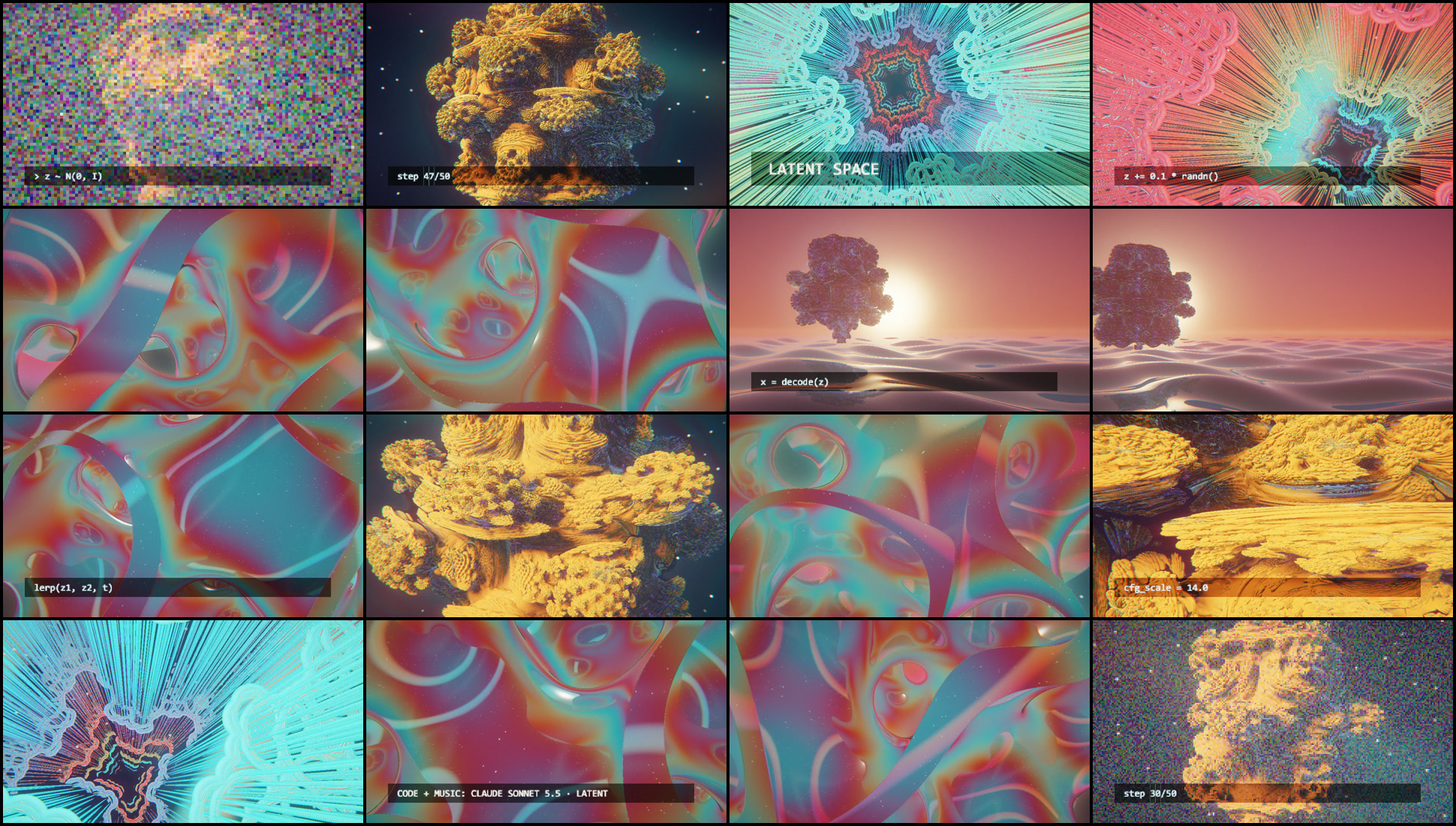
Video capture: media/latent_space.mp4 (1080p60, with soundtrack, 112 MB)
Run it
Double-click intro.html. A title screen shows progress while the soundtrack is rendered and the shaders compile (about 5 seconds). When it says "click to start", click: it goes fullscreen and plays for 2:13. ESC leaves fullscreen.
- Target: Edge or Chrome on Windows with a discrete GPU. Tested only on Edge with an RTX 5090, where a 1080p frame takes 1 to 4 ms.
- The picture is rendered at a fixed 1920x1080 and scaled to the screen.
- No server and no browser flags are needed.
Size
| File | Bytes | Notes |
|---|
intro.html | 6,772 | the release; 1,420 bytes under the 8,192 limit |
intro_fetch.html | 6,508 | same intro with the common fetch bootstrap; needs http:// or --allow-file-access-from-files |
dev.html | about 15,000 | unpacked build used for capture and debugging |
Timeline
The track is 144 BPM, so one bar is 1.667 s. A flash and a row glitch mark every cut.
| Bar | Time | Text | Scene |
|---|
| 0 | 0:00 | > z ~ N(0, I), then step 00/50 ... 50/50 | Noise in coarse blocks; the blocks halve and the noise fades with every step until a Mandelbulb is left, in gold and blue on a starfield |
| 8 | 0:13 | LATENT SPACE | The drop. Four shots (2 bars each) flying down the beam tunnel |
| 16 | 0:27 | z += 0.1 * randn() | Four shots of the iridescent gyroid ball |
| 24 | 0:40 | x = decode(z) | Breakdown: low flight over a sunset ocean, the Mandelbulb hangs in front of the sun; lead melody over a pad |
| 32 | 0:53 | lerp(z1, z2, t) | Second drop. Cuts every 2 bars between all four scenes |
| 48 | 1:20 | cfg_scale = 14.0 | Bridge: the camera falls into the surface of the Mandelbulb, 16 times closer in 13 seconds |
| 56 | 1:33 | CODE + MUSIC: CLAUDE SONNET 5.5 · LATENT | Last drop; from bar 64 the cuts come every bar |
| 72 | 2:00 | step 50/50 ... 00/50, > z ~ N(0, I) | The picture is noised again, block by block, back to nothing |
| 80 | 2:13 | | end |
How it works
One HTML file, no assets. Three fragment shaders, about 3.5 kB of JavaScript (including the title screen) and nine lines of text drawn with Consolas into a texture.
One distance field, four families (map() in src/scene.frag), chosen per shot from a table of 44 numbers:
- Mandelbulb with an animated power (6 to 8), coloured by an orbit trap (blue where the orbit stays close to the origin, gold on the outer ridges), a warm key light that follows the camera and a cool rim light.
- Beams: a kaleidoscopic IFS in the xy plane (abs, offset, rotation, scale 1.45, six times), with a thin cylinder and a bead (torus every 2 units) at each iteration. The tunnel is twisted slowly along z. The colour of every beam comes from its iteration and its distance from the camera.
- Gyroid:
|sin(x)cos(y) + sin(y)cos(z) + sin(z)cos(x)| as a thin shell inside a sphere, shaded as a thin film: the colour is a cosine palette of dot(n, rd), plus one reflection of a stripy studio sky. - Ocean: three sine waves as height field, the sun low on the horizon, sky reflection by Fresnel, soft shadows from the waves, and a Mandelbulb hovering in front of the sun.
Glow. While the ray marches, the distance to the glowing geometry (the beams, or the surface) is turned into light: exp(-k d) times the step length, coloured by a palette. That is the volumetric haze around the beams and the halo around the bulb, and it costs no extra steps.
Diffusion. The post shader renders the picture in blocks. The block size (64 px down to 1 px) and the noise amount follow a 50-step schedule (floor(50 * progress)), the noise is re-rolled on every step, and the step number is shown with digits cut out of a digit strip in the text texture. The same schedule runs backwards in the outro.
Post (src/post.frag). Bloom from the render target's mip chain, an anamorphic streak from the highlights, chromatic aberration, cut flashes with a row glitch (the scene shader passes the "a cut just happened" strength in the alpha channel), ACES tonemap, grain.
Music (src/music.frag). A fragment shader: one pixel per stereo sample at 48 kHz, 80 bars. A minor, one chord per bar (Am F C G). Kick, rolling off-beat bass, supersaw pad and stabs (three detuned voices per note, four harmonics each, so nothing aliases), plucked arpeggio and an eight-bar lead melody through a ping-pong dotted-8th echo, hats, clap, a snare roll and a noise and tone riser into every drop, and a sidechain pump on everything except the kick. At bar 76 one low hit ends it.
Packing is the same as intro 01; see ../01_gradient_descent/readme.md.
Credits and sources
No assets and no third-party libraries are included in the intro. Two well-known hash one-liners are used as published, and the rest was written for it using techniques that are common demoscene knowledge:
- The Mandelbulb is the "triplex" power-n formula of Daniel White and Paul Nylander; the distance estimate
0.5 log(r) r / dr is the usual one (see Mikael Hvidtfeldt Christensen's "Distance Estimated 3D Fractals" series at blog.hvidtfeldts.net, which also describes the folding IFS used for the beams). - The gyroid is the minimal surface found by Alan Schoen; the thin-film colour is a cosine palette as described by Inigo Quilez.
- The float hash
h1 is Dave Hoskins' "hash without sine" (hash12, MIT licence). - The integer hash in the music shader is the PCG hash (Jarzynski and Olano, "Hash Functions for GPU Rendering").
- Box distance function, soft shadows, the four-tap normal and the distance-based ambient occlusion follow Inigo Quilez's articles.
- The tonemap is Krzysztof Narkowicz's ACES fit.
- The noise-to-image idea is a nod to diffusion models (Ho, Jain and Abbeel, "Denoising Diffusion Probabilistic Models"); nothing of a model is in the intro, only the schedule.
- Rendering the soundtrack in a fragment shader is an established 4k/8k technique (Shadertoy sound shaders, 0b5vr's intros).
intro_fetch.html uses the fetch/DecompressionStream bootstrap known from 0b5vr's compeko packer. The double-click bootstrap in intro.html is our own.- Build tools: terser, zopfli (
@gfx/zopfli), puppeteer-core and ffmpeg. None of their code ends up in the intro.
Build and capture
From the repository root, with Node 22 and ffmpeg on the path:
node tools/build.mjs 04_latent_space
node tools/capture.mjs 04_latent_space sheet "5,9,11,16.3,19,21.7,26,30,36.7,41,48,52,63,68,75,84"
node tools/capture.mjs 04_latent_space video 133.4
node tools/audiostat.mjs 04_latent_space
node tools/capture.mjs 04_latent_space check 04_latent_space/intro.html
node tools/glcheck.mjs 04_latent_space/src/scene.frag    # compile one shader, with line numbers
Known limits
- The music was checked numerically only (no NaNs, peak 0.96, RMS 0.18 to 0.35). Nobody has listened to it yet, so the mix balance is a guess.
- Tested on one machine, with one GPU and one browser. Frame cost is low there (1 to 4 ms), slower GPUs were not tried.
- Some shots are chance: the beam tunnel is a fixed field and the camera can pass close to a fibre for a moment; in a few frames the gyroid fills the screen with one colour.
- The picture is noisy while the diffusion runs, by design, but the mandelbulb's fine detail also shimmers a little in motion (no temporal filtering).
- 1.4 kB of the budget is unused.
comments & votes