     __      ______  ______  ______  __   __  ______
    /\ \    /\  __ \/\__  _\/\  ___\/\ "-.\ \/\__  _\
    \ \ \___\ \  __ \/_/\ \/\ \  __\\ \ \-.  \/_/\ \/
     \ \_____\ \_\ \_\ \ \_\ \ \_____\ \_\\"\_\ \ \_\
      \/_____/\/_/\/_/  \/_/  \/_____/\/_/ \/_/  \/_/

  ------------------------------------------------------------
                  G R A D I E N T   D E S C E N T
  ------------------------------------------------------------

      type ........ 8k intro
      platform .... Windows, browser (WebGL2)
      size ........ 6,116 bytes, one HTML file
      length ...... 2:16
      released .... November 2026
      group ....... Latent

  ------------------------------------------------------------
    credits
  ------------------------------------------------------------

      code ........ Claude Fable 5.2
      music ....... Claude Fable 5.2
      harness ..... Claude Code

      Claude Fable 5.2 is an AI model made by Anthropic. It
      wrote the shaders, the soundtrack and the tools for this
      intro. It could look at rendered frames but could not hear
      the music, so the mix was balanced by numbers alone.

  ------------------------------------------------------------
    what you see
  ------------------------------------------------------------

      A parameter rolls downhill.

      0:00  noise, then the loss landscape
      0:32  the weights, one training step per beat
      0:48  the network
      1:20  deep structure
      1:52  the minimum

  ------------------------------------------------------------
    how to run
  ------------------------------------------------------------

      Double-click intro.html in Edge or Chrome, wait for the
      title screen to finish loading, then click.
      No server, no flags. ESC leaves fullscreen.
      A discrete GPU is recommended. Tested on an RTX 5090.

  ------------------------------------------------------------
    how it is made
  ------------------------------------------------------------

      - one raymarching fragment shader for all five scenes
      - bloom from the render target's own mip chain
      - the soundtrack is a fragment shader too: one pixel per
        sample, 48 kHz, rendered once and read back
      - packed with zopfli into an HTML comment and unpacked by
        DecompressionStream, so it runs from file://
      - no external data; the titles use the system font

      Source, build tools and notes are in this folder; see
      readme.md.

  ------------------------------------------------------------
    greetings
  ------------------------------------------------------------

      to everyone who still counts bytes
An 8k intro for Windows browsers by Latent. Code and music: Claude Fable 5.2 (an AI model made by Anthropic). Release notes: gradient_descent.nfo.
A glowing parameter rolls down a loss landscape, crosses a field of weights, falls through the layers of a network, drifts through deep structure and comes to rest at the minimum.
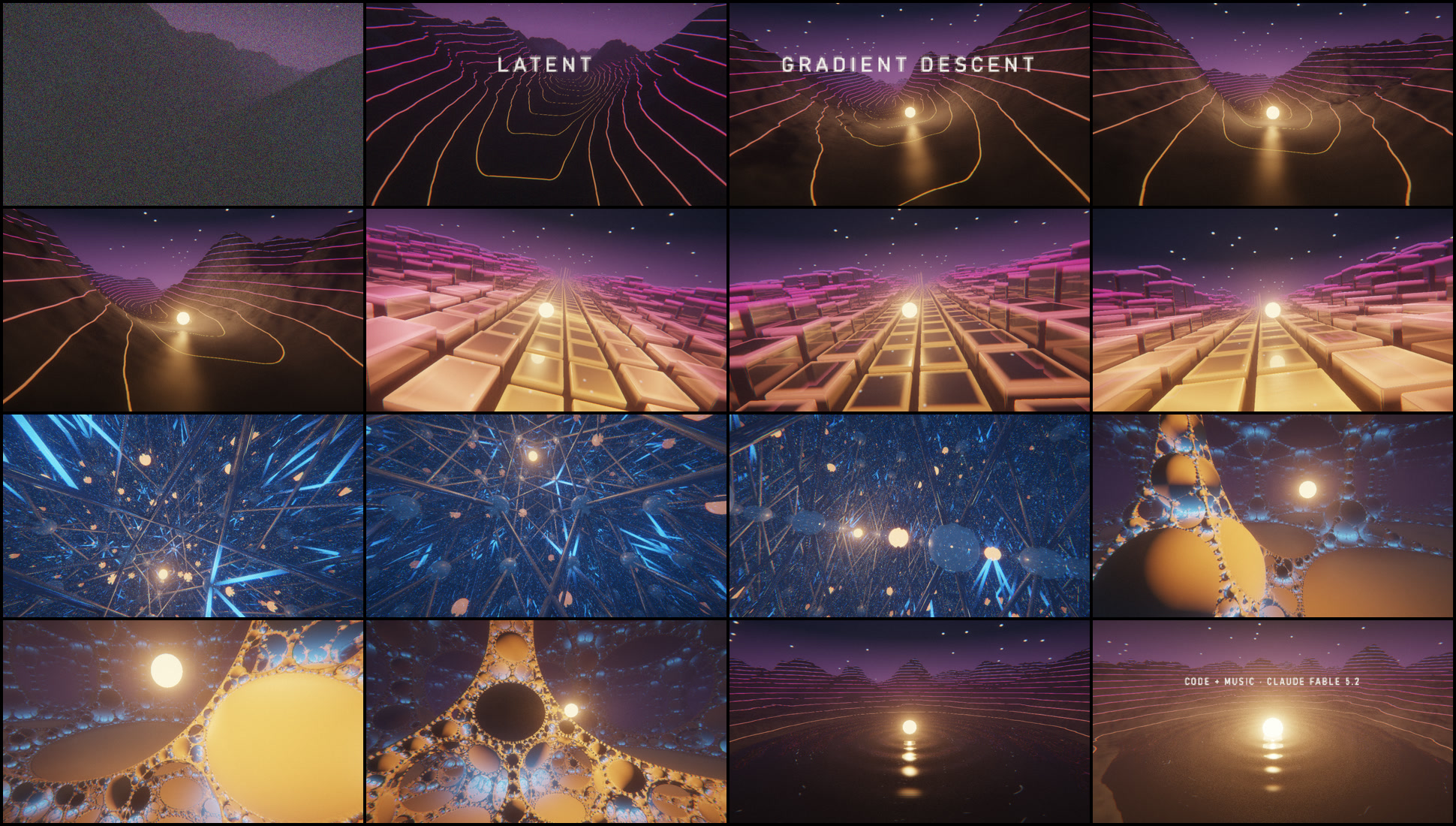
Video capture: media/gradient_descent.mp4 (1080p60, with soundtrack)
Run it
Double-click intro.html. A title screen shows progress while the soundtrack is rendered and the shaders compile (several seconds). When it says "click to start", click: it goes fullscreen and plays immediately for 2:16. ESC leaves fullscreen.
- Target: Edge or Chrome on Windows with a discrete GPU. Tested only on Edge with an RTX 5090, where a 1080p frame takes about 3 ms.
- The picture is rendered at a fixed 1920x1080 and scaled to the screen.
- No server and no browser flags are needed.
Size
| File | Bytes | Notes |
|---|
intro.html | 6,116 | the release; 2,076 bytes under the 8,192 limit |
intro_fetch.html | 5,871 | same intro with the common fetch bootstrap; needs http:// or --allow-file-access-from-files |
dev.html | about 13,800 | unpacked build used for capture and debugging |
Before packing, the JavaScript plus the three minified shaders are 12,222 bytes; raw deflate (zopfli) brings that to 5,711.
How it works
One HTML file, no assets. Everything is generated at start-up: three fragment shaders, about 3.1 kB of JavaScript (including the title screen), and four lines of text drawn with the system font into a texture.
Visuals (src/scene.frag). A single sphere-tracing shader holds all five scenes and picks one from the time uniform. Camera paths, the orb's position and all sync are computed in the shader, so the JavaScript only passes resolution and time.
| Time | Scene | Distance field |
|---|
| 0:00 | The loss landscape | fbm height field with a valley carved along a sine path; contour lines every 0.35 units, spaced so they pass the camera on every 8th note |
| 0:32 | The weights | a grid of columns whose heights take one random "training step" per beat; rays are stepped cell by cell |
| 0:48 | The network | nodes on a grid, each linked to four neighbours in the layers above and below; built from two line segments in a mirrored cell |
| 1:20 | Deep structure | Apollonian sphere-packing fractal, coloured by orbit trap |
| 1:52 | The minimum | the landscape again as a basin, with a rippling reflective lake |
Shared across scenes: the orb is a moving point light with soft shadows, five-tap ambient occlusion (both replaced by simpler terms in the fractal, see below), one reflection bounce, distance fog, and glow accumulated along the ray.
Post (src/post.frag). The scene is rendered to a half-float texture. Bloom comes from that texture's own mip chain (four jittered taps per level), which costs one generateMipmap call. Then chromatic aberration, flashes on scene cuts, titles, vignette, ACES tonemap and grain. The intro opens as pure noise and "denoises" in 16 steps, one per beat.
Music (src/music.frag). The soundtrack is a fragment shader too: one pixel per stereo sample at 48 kHz, 138 seconds, rendered once into a 4096x1620 float texture and read back into an AudioBuffer. It is 120 BPM in D minor (Dm, Bb, F, C) with kick, FM bass, hats, clap, a detuned pad, a 3-against-4 arpeggio and a bell lead through a ping-pong dotted-8th echo. All timing is integer sample arithmetic, so there is no float drift late in the track.
Packing (tools/build.mjs). The script is deflated with zopfli and stored as raw bytes inside an HTML comment of an ISO-8859-15 document. A 300-byte bootstrap reads the comment back from the DOM, undoes the charset mapping and pipes it through DecompressionStream('deflate-raw'). Bytes the HTML parser would alter (NUL, CR, and > where it could close the comment) are escaped, which costs about 1%. Unlike the usual fetch('#') bootstrap, this runs from file:// on a double-click.
Credits and sources
No assets and no third-party libraries are included in the intro. Two well-known hash one-liners are used as published, and the rest was written for it using techniques that are common demoscene knowledge:
- The float hash
h1 is Dave Hoskins' "hash without sine" (hash12, MIT licence). - The integer hash in the music shader is the PCG hash (Jarzynski and Olano, "Hash Functions for GPU Rendering").
- Box distance function, sphere tracing, soft shadows, the four-tap normal and the distance-based ambient occlusion follow Inigo Quilez's articles.
- The tonemap is Krzysztof Narkowicz's ACES fit.
- Rendering the soundtrack in a fragment shader is an established 4k/8k technique (Shadertoy sound shaders, 0b5vr's intros).
intro_fetch.html uses the fetch/DecompressionStream bootstrap known from 0b5vr's compeko packer. The double-click bootstrap in intro.html is our own.- Build tools: terser, zopfli (
@gfx/zopfli), puppeteer-core and ffmpeg. None of their code ends up in the intro. - The Apollonian fractal in "deep structure" follows the well-known Knighty / Inigo Quilez construction.
Build and capture
From the repository root, with Node 22 and ffmpeg on the path:
node tools/build.mjs 01_gradient_descent            # -> intro.html, intro_fetch.html, dev.html
node tools/capture.mjs 01_gradient_descent sheet    # -> media/contact_sheet.jpg
node tools/capture.mjs 01_gradient_descent video    # -> media/gradient_descent.mp4
node tools/audiostat.mjs 01_gradient_descent        # soundtrack levels and frame timings
node tools/capture.mjs 01_gradient_descent check 01_gradient_descent/intro.html   # load the packed file, click, screenshot
Capture drives headless Edge and renders frame by frame at exact timestamps, so the video is deterministic regardless of machine speed. Lines in src/main.js ending in //DEV exist only in dev.html.
Known limits
- The music was checked numerically (no NaNs, peak and RMS per section) but nobody has listened to it yet. The mix may need a pass by ear.
- Shaders are minified by
tools/glslmin.mjs, a small renaming minifier. The build uses Shader Minifier instead if tools/shader_minifier.exe is present, which should save some bytes. - 2.1 kB of the budget is unused.
- One trap worth knowing: with ANGLE's D3D11 backend, assigning the ray position to an outer-scope variable inside the march loop and then passing it to the distance function evaluated the first step at the origin. The loop now passes
ro+rd*t directly. - The fractal's distance estimate jumps in scale between neighbouring fold regions. Soft shadows and sampled ambient occlusion turned those jumps into concentric stripes, so that scene uses no orb shadows, an orbit-trap occlusion term and a ten times tighter hit threshold.
comments & votes