Recent

AI Image Generation on an RP2350 Microcontroller
·1677 words·8 mins
A tiny diffusion transformer running on a $1 RP2350 microcontroller can generate 128×128 pixel images of human faces.

Glowing Polyhedrons
·2861 words·14 mins
Building wireframe polyhedra made from LED filaments, using graph theory to devise geometry and driving strategies.
BitNetMCU with CNN: >99.5% MNIST accuracy on a low-end Microcontroller
·2261 words·11 mins
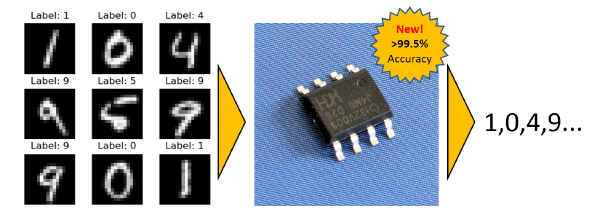
Combining a deep-depthwise CNN architecture with variable quantization in BitNetMCU achieves state-of-the-art MNIST accuracy on a low-end 32-bit microcontroller with 4 kB RAM and 16 kB flash.

Measuring Thinking Efficiency in Reasoning Models: The Missing Benchmark ↗ ↖
·7 words
(Guest article on the Nous Research blog) Anecdotal evidence suggests open weight models produce significantly more tokens for similar tasks than closed weight models. This report systematically investigates these observations. We confirm this trend to be generally true, but observe significant differences depending on problem domain.

Candle Flame Oscillations as a Clock
·1869 words·9 mins
Todays candles have been optimized not to flicker. But it turns out when we bundle three of them together, the resulting triplet will start to naturally oscillate. Amazingly, the frequency is rather stable at ~9.9 Hz as it mainly depends on gravity and diameter of the flame. We detect the oscillation with a suspended wire and divide it down to 1 Hz.